First Steps To Getting Your Music Considered For TV/Film Placements
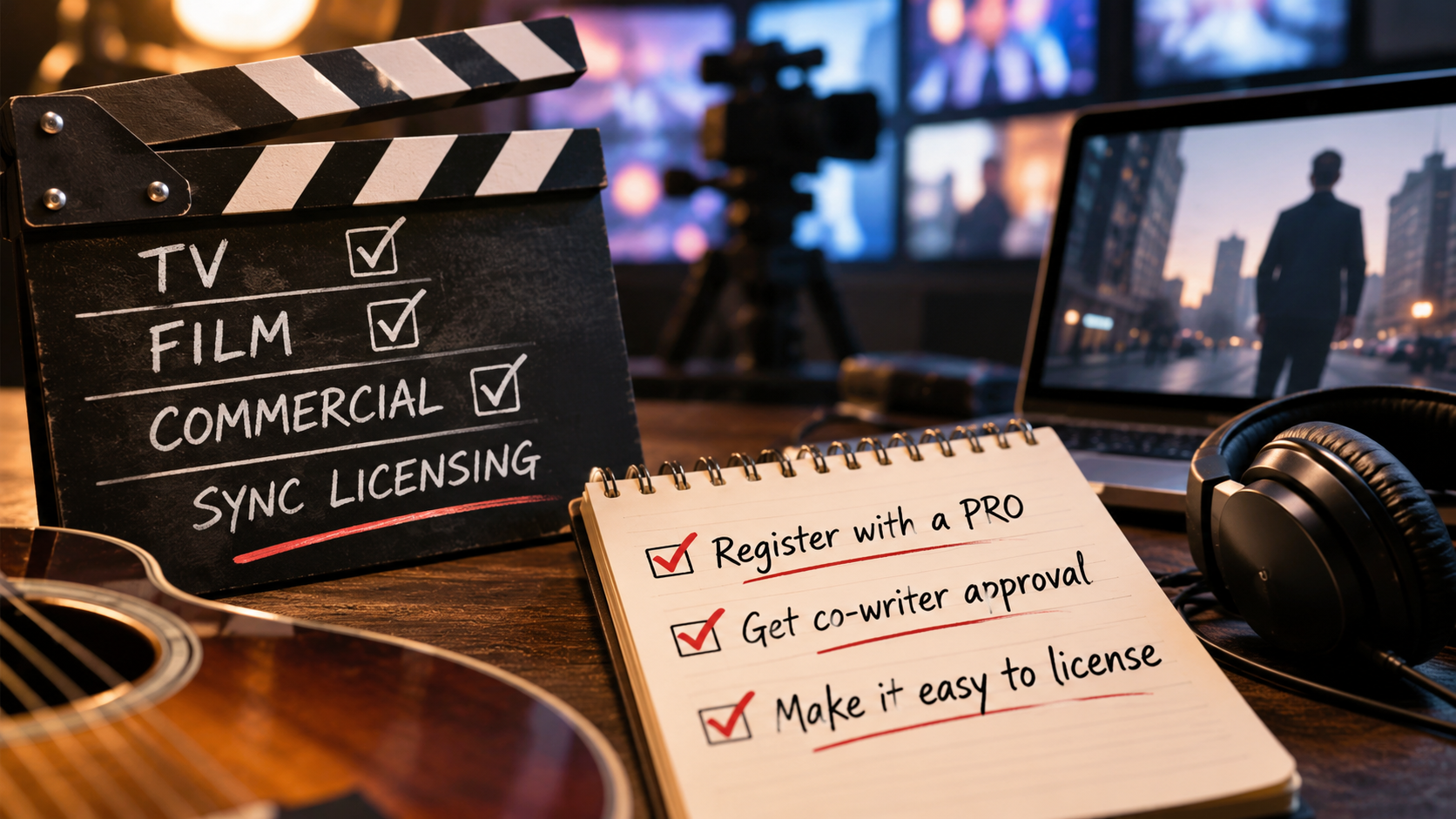
Everyone wants to hear their music in a TV show, movie, or national commercial. Not only is it incredibly cool to hear your song playing on television, but it's also an amazing opportunity to gain exposure, reach new fans, and actually get paid for the use of your music.
But what many independent artists overlook are the important steps that need to happen before that opportunity comes along.
And believe me, when those opportunities do arise, things can move very quickly.
Step 1: Register Your Music With a PRO
One of the first things you should do as a songwriter is register your songs with a Performing Rights Organization (PRO), such as ASCAP or BMI.
A PRO helps songwriters and publishers collect performance royalties when their music is publicly performed, including on television, radio, and other platforms.
But there's another important reason to register your music, especially if you're hoping to land placements in TV, film, commercials, or video games.
When a music supervisor is interested in licensing your song, one of the first things they need to determine is who owns the rights to the music and who has the authority to approve its use.
Registering your song with a PRO, with accurate songwriter and publisher information, helps make that process easier.
Now, technically, you don't need a PRO registration to license a song. However, having your music properly registered and your ownership information organized can make the licensing process much smoother. It also helps ensure you're positioned to collect performance royalties when your music is used in eligible broadcasts.
The last thing you want is for a music supervisor to love your song but struggle to figure out who needs to approve the license.
And trust me, they aren't going to spend forever trying to figure it out. There are plenty of other songs they can choose from.
Step 2: Get Pre-Approval From Your Co-Writers and Publishers
This is something I strongly recommend to artists, especially those who regularly collaborate with other songwriters.
Get your co-writers' and co-publishers' approval for potential sync licensing opportunities before an opportunity ever presents itself.
Why?
Because when a music supervisor or licensing agent contacts you about using your song in a TV show, film, commercial, or video game, they may need an answer within hours.
Not days. Not next week. Sometimes hours.
Imagine getting a phone call saying a major TV show wants to use your song, but you need to track down a co-writer who happens to be on vacation, unreachable, or simply not checking their email.
That delay could cost you the placement.
One way to make the approval process easier is to establish a written pre-clearance agreement with your co-writers and publishers. That agreement can outline who is authorized to approve licensing opportunities and under what financial terms.
You can also establish what's called a Most Favored Nations (MFN) arrangement.
What Does Most Favored Nations (MFN) Mean?
MFN is a contractual provision that helps ensure the parties covered by the agreement receive equally favorable licensing terms, often relative to their ownership shares.
For example, if two co-writers each own 50% of a song, an MFN provision can help ensure that neither receives a better rate for their share than the other. MFN terms are also commonly used to keep the licensing fees for the master recording and publishing sides equal.
The important distinction is that MFN addresses the financial terms, while a separate pre-clearance agreement establishes who has the authority to approve the license.
And here's my advice: If you're the artist actively pursuing licensing opportunities, try to negotiate that approval authority for yourself.
Naturally, your co-writers and publishers need to be comfortable with the arrangement, and you can establish boundaries around acceptable uses and minimum licensing fees.
By working these details out in advance, you can make everyone more comfortable with granting pre-approval while putting yourself in a much better position to respond quickly when an opportunity arises.
Remember, the goal isn't just to make your music available for licensing. It's to make it as easy as possible for someone to actually license it.
The fewer obstacles standing between a music supervisor and your song, the better.
Step 3: Become a "One-Stop Shop"
Now we're getting to what I consider the holy grail of music licensing.
Being a "one-stop shop."
In the music industry, a one-stop shop means that a single person or company has the authority to clear both the songwriting/publishing rights and the master recording rights for a particular song.
Remember, there are generally two separate copyrights involved when licensing an existing recording:
- The composition: The underlying song, owned or controlled by the songwriters and publishers.
- The master recording: The actual recorded version of the song, usually owned or controlled by the artist, record label, or whoever financed and owns the recording.
If you own your master recording and have the proper authority from all co-writers and publishers to approve the composition's use, you may be able to offer your song as a one-stop license.
And that's incredibly attractive to music supervisors.
Instead of chasing down multiple songwriters, publishers, record labels, and other rights holders, they can potentially make one phone call, negotiate the licensing terms, and get the song cleared.
Of course, you'll still need to agree to the financial terms, how the song will be used, and the other details of the licensing agreement.
But you've already eliminated one of the biggest potential obstacles.
The easier you make it for someone to license your music, the more attractive your music becomes for licensing opportunities.
A Personal Story: Hearing My Brother's Song on National Television
I'll never forget one particular licensing experience involving my brother's song, "Counting On You."
We had agreed to license the song for the trailer of a major motion picture starring Jessica Biel and Gerard Butler.
From our end, everything was approved. We had agreed to the financial terms and signed off on the usage.
But there was one catch.
The placement hadn't been officially confirmed on their end.
So, while we were excited, we still didn't know whether the song was actually going to make it into the final trailer.
Fast-forward to being on tour with my brother.
We were checking into our hotel room, exhausted, and I turned on the television. CBS happened to be on.
And suddenly, there it was.
The movie trailer was playing on national television, with my brother's song "Counting On You" as the soundtrack.
That was how we found out the placement had gone through!
It was an incredible feeling.
Not only did we know that a licensing check would be coming our way, but, more importantly, my brother's music was suddenly being heard by an enormous national audience.
At that early stage of his career, that kind of exposure was invaluable.
It meant potential new fans, new listeners discovering his music, and an opportunity to introduce his songs to people who otherwise might never have heard them.
And that's what makes music licensing so exciting.
It's not just about the money. It's about where your music can take you.
Final Thoughts:
If you're an independent artist hoping to land your music in television, films, commercials, or video games, don't wait until an opportunity comes along to get your business in order.
Register your songs with a PRO. Make sure your songwriting splits and publishing information are accurate. Understand who owns your master recordings. And if you work with co-writers, have conversations now about how future licensing opportunities will be handled.
You never know when a music supervisor might come across your song and decide it's exactly what they're looking for.
When that happens, you want to be ready to say yes.
Because sometimes, the difference between landing a major placement and missing out on one comes down to how quickly you can get the music cleared.
And take it from someone who's been on the receiving end of that phone call: There's nothing quite like hearing your music on national television.